

The Perfomance Trap
When the signals of good work become the work itself.

Twenty minutes!
I had been silent for twenty minutes.
I wasn’t exactly disengaged.
I just didn’t have anything to contribute.
But silence often carries the impression of disengagement.
The AC hummed.
Someone tapped a pen.
I felt the gaze of a senior colleague.
My pulse quickened as I sensed the silence closing in.
I knew what came next.
Suffocation!
I leaned forward on the conference table.
Asked a question.
To breathe.
To break free.
A question I knew didn’t need answering.
“Have we thought through the downstream implications?”
It sounded smart.
People nodded.
Yet in that moment, I sensed a split.
A second awareness.
Standing a few feet away.
Watching!
That observing self wasn’t angry.
It was tired.
Slightly disappointed.
It knew better.
It knew that I knew better.
That was what made it sting.
I worked late on Thursday evenings.
No deadline demanded it.
Just the hope that someone will see me.
Still in the office at 10:30 PM.
Those emails I wrote were fine at version one.
But they lacked something.
Signals of competence.
So I rewrote them.
Again!
And again!
Scheduled them to be sent at an odd hour.
Just in case someone noticed.
Yes, I’d split in two.
There was the performer.
The one who acted out a persona.
Asked the right questions.
Held the room.
Got the nods.
And then there was the observer.
The one watching the whole act unfold.
Knowing it was hollow.
But felt utterly helpless to intervene.
The performer absorbed the approvals.
The observer absorbed the true discomfort of feeling like a fraud.
And I couldn’t merge them back together.
Because the system recognises the performer.
It ignores the observer.
So the performer keeps performing.
While the observer watches, unable to stop it.
This is the Performance Trap.
And the question staring back at me was...
When did this happen?
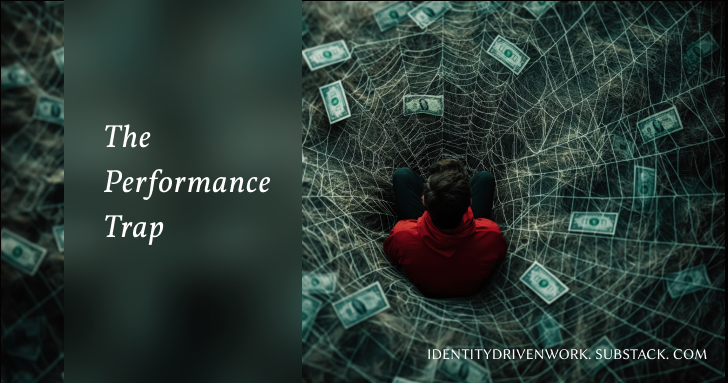
It started innocently
In the beginning, there was no split. The performer and the observer were the same because you genuinely cared about the work, and for a while, that seemed like enough. You did great work, and it was recognised. You were praised in meetings, trusted with more responsibility, seen as someone who delivers. And it felt good. Really good.
So you did more of it. You invested in your skills, doubled down on quality, and kept delivering great work because the pattern seemed obvious: high-quality work leads to recognition. And for a while, it really did. But over time, something shifted.
You were still producing good work, but the recognition didn’t always follow. And on the occasions it did, it wasn’t always for the best work. That’s when you really started paying attention. Not just to what works, but to what gets recognised. And slowly, you realised something uncomfortable: the system doesn’t necessarily reward the best work. It rewards the most visible work. It rewards the shiniest slides. It rewards those later than late-night email replies.
You think: “I can do this. I can optimise for visibility.” So you start adjusting the packaging. You start being strategic when you go about it. You reply even faster to emails, take more charge in meetings, and polish your updates ever more deliberately. Ever more intentionally. Ever more consciously. And it works. The recognition returns. In many cases, it even increases.
But there’s an uncomfortable truth lurking underneath. The optimisation never stops there. Slowly, over time, the signals begin to take priority. Responding quickly becomes more important than responding thoughtfully. Being present in meetings becomes more important than contributing meaningfully. And before long, looking productive becomes far more important than actually being productive. Gradually, the balance begins to shift.
Yes, you’re still doing the work. But more and more of your attention now goes into optimising how the work appears rather than the work itself. The signals start to shape the substance until eventually... they replace it. You’re no longer doing meaningful work and then sending it over to your colleagues and seniors. Rather, you’re performing the act of being productive as the work itself. The signals are the work now.
You become excellent at asking questions that signal intelligence, crafting emails that project competence, and staying visible in all the right ways. But underneath the performance, the deeper capacities start to wither. That thinking that gave you the edge early on slowly start feeling out of reach. That depth that made your ideas fresh in the first place, you start missing it. That capacity to sit with difficult problems long enough to produce meaningful work is just not there any more. And because the system consistently rewards the signals, you can’t stop optimising for those very signals.
That’s the trap. And...
everyone’s in it
In a 2013 blog post about managers who mistake busyness for work, marketer Randy Murray coined the term "productivity theatre." Back then, it was more of a management observation: if your people always look highly, highly busy, odds are they are putting on a show, performing work more than actually doing it.
Inc picked it up soon after. Then, almost a decade later, at the tail end of the COVID pandemic, hybrid work exposed the same pattern at scale. In its Work Trend Index Special Report, Microsoft surveyed 20,000 professionals across 11 different countries and found the same productivity paranoia surrounding hybrid work: managers struggling to trust that employees were actually working without the old visual cues of productivity. Microsoft used the same term, “productivity theatre,” to describe it.
In the report, 85% of leaders said out loud what was supposed to be whispered in trusted circles: in the absence of highly visual cues of productivity, they found it difficult to trust employees to be productive. At the same time, 87% of the employees reported being productive. And 42% reported multitasking during the meetings, actively sending emails while on calls. A tell-tale symptom of the pressure they felt to “prove” they were working.
When the “quiet quitting” trend exploded, millions of workers simply decided to do their jobs. Or as the rebrand called it, “acting the wage.” Employees met their KPIs, finished their tasks, but stopped the “extra” stuff around the work. No more speaking up in optional meetings just to be seen. No more emails after 10 pm. No more instant Slack replies or staying late. People still did the baseline work. They just stopped putting on the show.
If the system actually cared about the real work, managers would have tracked the metrics and said, “The core KPIs are still being met. That’s actually great.”
But that’s not what happened. The system panicked. Business leaders labelled quiet quitters as “lazy” with poor work ethics. Managers called them “disengaged” and complained they were burdening the rest. The backlash revealed the true structure: even if the work gets done, in the absence of signals, you will be punished. The performance had become an implicit part of the job.
And when higher management imposed the Return-to-Office (RTO) mandates, purely because they missed those visible cues of productivity they craved, employees responded by “coffee badging.” Swipe the badge at 9 am, grab a coffee, make sure the boss sees you, and leave by 11 am to go home, and do the actual work. This is the ultimate proof of the trap.
Now, generative AI has reduced the cost of producing those signals close to zero. It doesn't do the deep, unstructured work of thinking through edge cases and limiting scenarios. But what it does do, and dare I say exceptionally well, is generate the signals of visible work. It creates the meeting agenda, those polished weekly updates, the thoughtful email replies, all in one single breath.
And if you thought this trap is just limited to the corporate world, you’re mistaken. It’s now coded into the very fabric of the elements shaping the modern culture. Look at the recommendation algorithm behind any of the social media platforms. It’s the ultimate invisible manager. This algorithm is literally incapable of responding to the meaning behind the posts. All it cares about are the signals. Click-through rate, time spent on posts, frequency of posting, engagement metrics.
And creators who thought they were leaving this trap behind back in the corporate world, just traded a human manager for a machine one. So what do they do? They join engagement pods, optimise for the social media algorithm, and learn how to game the system. Because at this point, that’s what the work has become: a game of signal optimisation.
Since the generation of signals is now frictionless, we have entered the era of Dead Loops. You use AI to craft a thoughtful 500-word email. Your colleague, at the other end, uses AI to summarise that very email into 3 bullet points that barely register in their consciousness. Take a step back and look at what just happened here. No human actually thought through the scenarios in any depth. But the performance was executed flawlessly. The system tracked the email, noted the response time, and recorded the right markers of productivity. All signals of visible work are firing at full tilt.
There is a social media version of this AI dead loop, too. You use AI to create a Substack note or a Twitter post. Someone else uses AI to comment on it. And then you use AI to respond to that comment. Pause here for a moment to ask yourself, “What just happened? What is this?” This is pure simulation. Signals responding to signals. And the system, or the algorithm in this case, is absolutely thrilled.
Since everyone now has access to the same signal-generating machine, i.e., AI, imagine what happens to the baseline? What does ‘looking productive’ even mean now? Visibility inflation takes over. If everyone can produce ten top-notch presentation reports in a week, what’s the new standard of visibility? Is it fifteen? Or is it twenty? If everyone can now post five times daily, how many times would you have to post to stand out? The standard shifts to ten or to even fifteen. And it keeps shifting. You are now competing in a performativity arms race. If you insist on doing the deep, authentic work, you don’t just look slow; you look completely incompetent. You disappear entirely beneath the volume of signals everyone else is pumping out.
The gap between signals and the actual work has never been wider. You can now perform the signals at scale without engaging in any depth with the work itself. And the systems around you keep on rewarding this very performance. The only question in front of you is whether you’ve noticed it yet, and what...
the trap costs?
It begins with a feeling, manifesting as a slow dread. And it accumulates over time until eventually you start feeling like a fraud. Everyone tells you it’s just that Imposter Syndrome. Something to overcome. But what if this feeling is a highly accurate perception of your reality? What if your mind is responding honestly to the split you’ve created within you? You feel like a fraud because you know the performance is a show for maintaining the optics. The work you are being praised for is highly optimised for one thing and one thing only: Signals of visibility. The competence you demonstrate in meetings, those perfectly timed email updates, and the polished presentations were all geared towards signalling expertise rather than actually creating work that matters. And that observer self in the conference rooms? It’s your authentic self, recognising the gap. It’s staring at the performance and realising how hollow the work underneath has started to feel.
The psychological term for this split is self-alienation, but the practical consequences of this very split run far deeper than just feeling disconnected from yourself. The Performance Trap doesn't just make you feel fake... it makes you become fake. It reshapes who you become, over time. The skills required to perform the appearance of great work are fundamentally different from what is required to do meaningful work. Performance requires rapid-fire responses, polished takes, predictable publishing schedules, visible activity, and being constantly on the lookout just so you can position yourself strategically in the right communication channels. Whereas, meaningful work demands deep thinking, struggles that are not visible to others, the ability to tolerate prolonged confusion and uncertainty, and long periods of sustained focus. You inevitably get better at what you practice. And if you spend forty hours every single week broadcasting signals of visible work, that is exactly what you get good at. You end up starving your capacity for depth. Your ability to do actual, meaningful work wanes. At the same time, you become a master at maintaining the appearance of competence day after day, week after week, month after month, year after year.
Now scale this decline in the individual’s ability to do meaningful work across an organisation. Then scale it across a complete economy. Eventually, across an entire Civilization. Where do we end up? What emerges is a system sustained purely by theatrics. Meetings are packed with engagements but are simultaneously empty of meaningful decisions. Stunning strategy decks that, ironically, say less and less. Polished weekly reports optimised for visible progress while containing little actual insight. Employees perform for the managers. Managers perform for the higher management. Higher management performs for the CEO. And the CEO performs for the investors. The performance becomes entirely self-referential. The most terrifying part is that this simulation can sustain itself far longer than you would ever imagine possible because everyone is too busy evaluating everyone else’s performance to slow down long enough and ask if actual work is happening underneath it all. We are no longer asking if it is good work. We only ask if it resembles the acceptable signals of good work. And by the time the hollowness becomes impossible to ignore, the deeper capacity for meaningful work might already have withered away.
Across an entire generation.
So...
How do you escape?
You stop the performance? Right?
You step off the stage?
No more signals of competence.
No more perfectly timed emails.
No more strategic presence in meetings.
No more polished Slack updates.
You put your head down and just do good work. Focused. Quietly
You think, maybe this was the answer.
And for a brief moment, it could even feel liberating.
Until the system notices, and says:
“Where is Nik?”
“He seems disengaged.”
“He is losing his edge.”
“He doesn’t look like a team player any more.”
Even if the quality of your work goes up, your visibility declines. And in systems built to recognise signals, invisibility is equated with underperformance. Your manager doesn’t see the depth of your thinking behind your work. But they do notice your absence from the meetings. The algorithm doesn’t recognise the hours you spend refining an idea. But it does notice the drop in your posting frequency and subtly buries your posts.
The irony is difficult to miss. The system asks you to be authentic and then punishes you for behaving in an authentic way. On the surface, it celebrates originality, but in reality, it exclusively rewards conformity.
This is...
the Performance Trap!
And you don’t escape it.
Not completely.
Not while you operate inside these systems.
Because the truth is, you will perform.
The question is whether you notice it.
Whether you catch yourself in the conference room.
Whether you pause before responding to that email and ask:
Is this the performance I chose?
Or did the system choose it for me?
Because there is a difference between unconscious performance and consciously chosen performance.
Unconscious performance makes you respond to whatever the system rewards without ever questioning what, or who, it’s asking you to become.
Conscious performance makes you recognise the signals for what they are. Just signals. And choosing which ones are worth using in service of work that truly matters to you.
Yes, you are not just what you perform.
But you will be judged, in parts, by how your performance looks from the outside.
Because you don’t get to choose whether you perform.
You only get to choose whether your performance is unconscious or intentional.
The real question was never:
How do I stop performing?
It always was:
What performance is worth the cost?
And because every performance asks something of you, the question becomes what you’re truly willing to trade.
Some performances ask for your attention.
Some test your integrity.
Some costs you pieces of yourself you only notice once they’re gone.
You cannot avoid the trap.
But you can decide what you are willing to pay to live inside of it.
Choose your cost,
Nik Pathran
Subscribe to Identity-Driven Work for
insights on building a body of work
that is authentically yours.
This is a great piece, Nik.
When I was once discussing a promotion I believed was deserved, my manager told me that I had to be visible in the right ways so it looked deserved, and she presented what would be helpful for me to do. I said to myself, I'm not playing that. All of those suggested things felt like theatre immediately because I had no genuine interest, and yet I was supposed to look thrilled to do it. So I didn't do it. The promotion came eventually, as a surprise, when I had already decided to leave, and shortly before I announced my resignation. I never did the late-night emails sending thing, never did any performed engaged participation on anything... I was guarding my life and refusing to pretend something that was not true to me. Getting great feedback on the actual work wasn't enough for recognition. They wanted me to do something that would also mean the managers hit their KPIs.
Or my manager was complaining that my Teams were switched off, so people couldn't reach me in case of emergencies. I said I'm still receiving emails + I'm switching off notifications so I can focus on ICFs (something you just need sustained focus for). It didn't fly. I couldn't believe it. That caused a big conflict in me. And those things were stacking. Leaving was a big relief in that I could completely pull myself out of that.
I've had a few quieter periods here on Substack in the last few months, and every time, I feel the same concern - that I won't be rewarded for my hard work. And, clearly, that means visible hard work. Because the hard work never stops, it just doesn't always translate into something visible. Sometimes it's underground, and I know at that point that doing the visible one would be a performance just for the sake of visibility.
It's getting weaker with each wave of underground work, because a part of me knows better, but it's still there. Even as the performer doesn't play the game, the observer is left to process it.
Nice one… the human made& real universe always have different rhythm. a seeker outgrows circumstances& learnings. But purpose of task is part of all work& but how it aligns with real life (greater purpose, values, ability to stay inspired) is part of living& not just a job.