

The Cost of Identity Debt
Why that feeling of being an 'impostor' is the most honest signal you have.

The seemingly irrational impostor syndrome is often a perfectly rational response to a deeper underlying problem.
We don't feel like imposters because we lack skills or confidence. We feel like imposters because, on some level, we truly are.
We perform — acting out a version of ourselves that is professionally convenient but personally foreign. The deeper problem isn't just the feeling of being a fraud. It's the already high and increasingly compounding cost of work and career built on being that fraud.
It's the debt owed to your own identity. It's the Identity Debt.
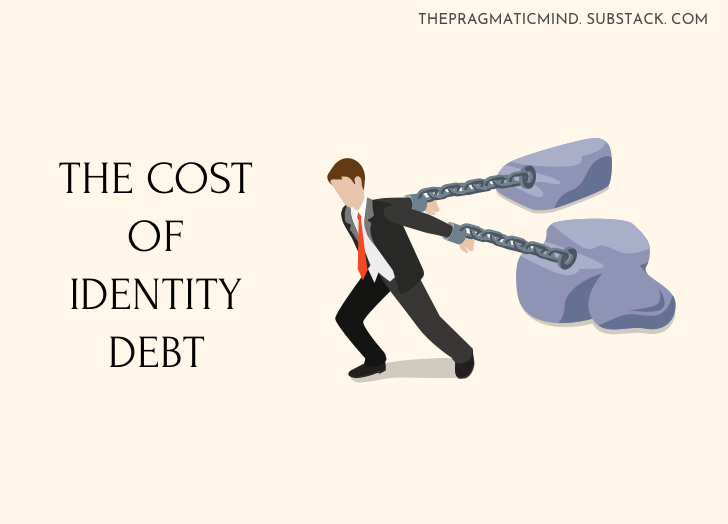
Like financial debt, it rarely happens all at once. It accumulates, over time, through a series of small, seemingly insignificant choices. Saying "yes" to a project that dulls your spirit. Holding back your creative writing for fear of looking foolish. Accepting praise for work that didn't feel like your true self. And the identity debt keeps on compounding. Quietly. Insidiously.
The persona you once adopted for survival starts to feel permanent. You work so hard to maintain the facade that you forget who you were before you built it.
This feeling of being split in two — the real, true self and your impostor self — is a fundamental conflict in the human psyche. One that psychologists have studied for decades. E. Tory Higgins gave it a name: Self-Discrepancy Theory.
We are all continually navigating three different versions of ourselves:
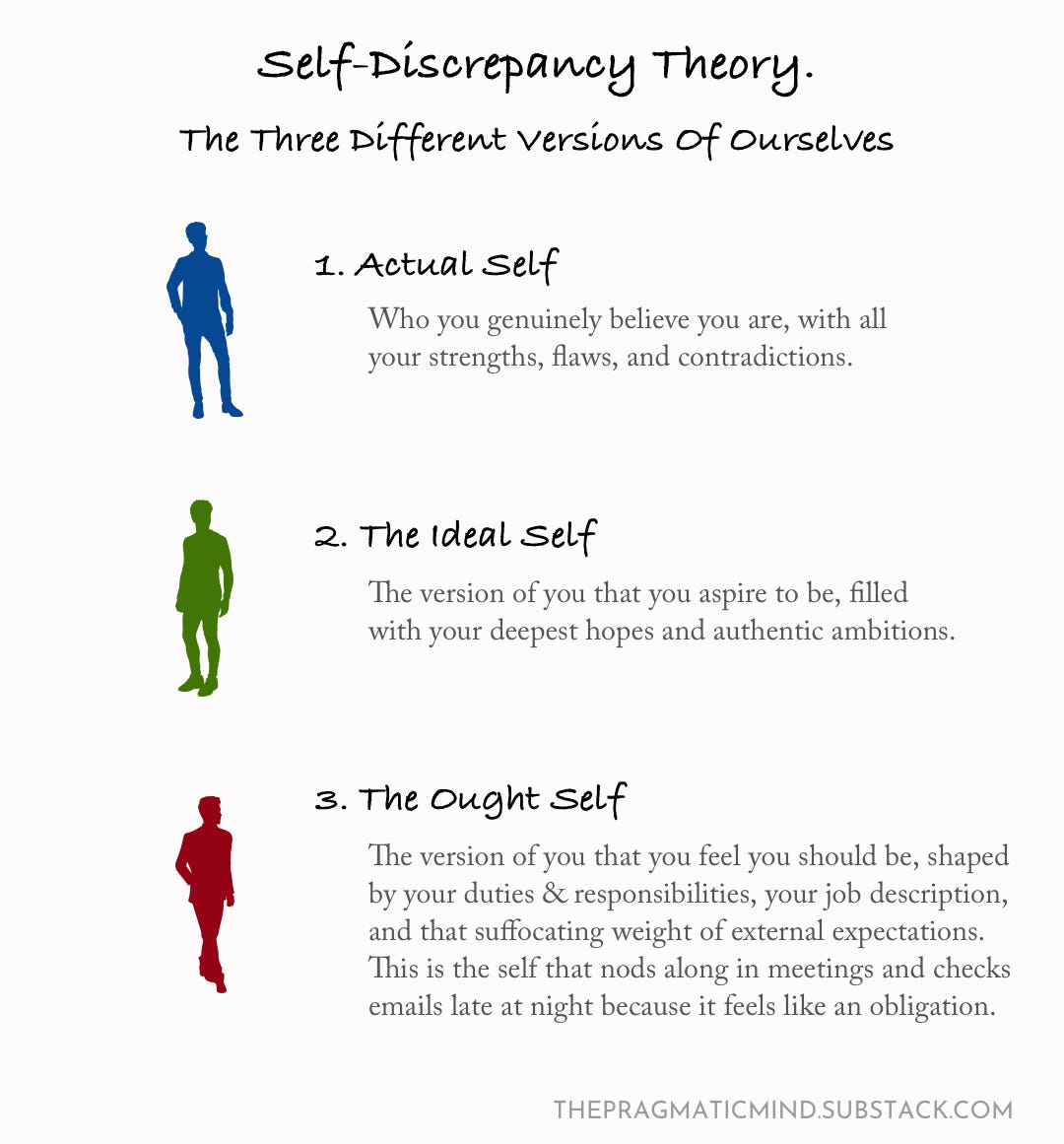
Higgins's groundbreaking insight: a large gap between your "Actual Self" and "Ideal Self," and "Actual Self" and "Ought Self" is a direct source of psychological pain. It's the breeding ground for anxiety, stress, frustration and guilt.
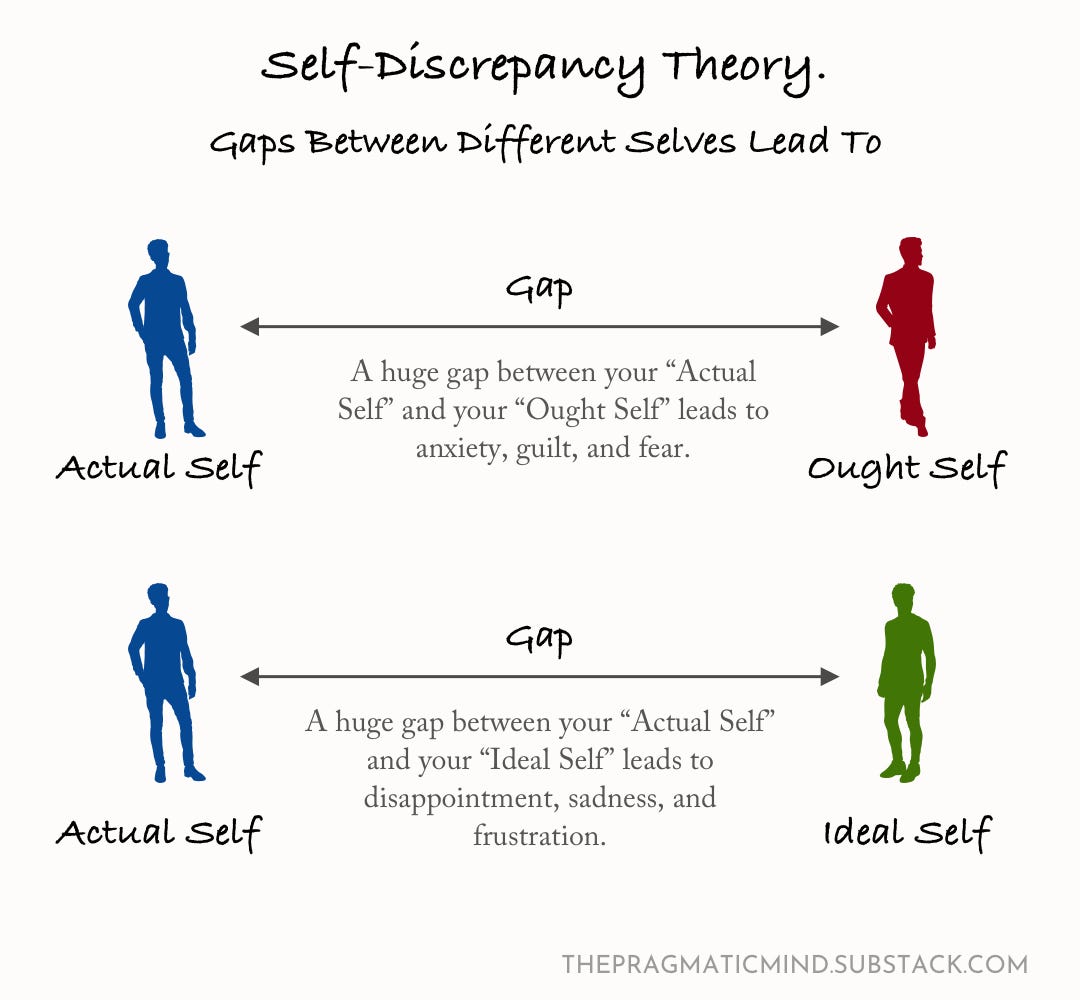
This is why success can feel so hollow. A success your "Ought Self" ordered, but whose consequences your "Actual Self" is left to bear.
The Four Deficits of Identity Debt your "Actual Self" bears
Understanding the deficits is the first step in meeting your identity debt obligations. Each deficit extracts its own price. Each deficit compounds the others.
1. The Creativity Deficit
When you're disconnected from your authentic creative voice, every creative act feels like fraud. You edit before you create. You judge before you express. You optimize for safety, whereas creativity requires risk.
This is the Creativity Deficit. It shows up as procrastination on the projects that truly matter to you. You spend hours crafting the perfect status report, but edit out the creative work that feels like it's coming from your soul. Your work could just as easily have been done by anyone else because you systematically delete everything that makes it distinctly yours.
This deficit is the cost to your most original ideas. It's the slow, painful death of your unique voice, replaced by safe, generic, corporate-approved expression. It's paralyzing because it feels completely alien.
2. The Emotional Deficit
That persistent, low-grade anxiety of being an impostor in your own life. You feel disconnected or numb even during moments of success. You develop a secret resentment toward people who seem to be doing work they love, dismissing them as naive or unrealistic.
This is the Emotional Deficit. It's the cost to your inner world.
You experience what I call "success depression." It's achieving things that should make you happy, but leave you feeling empty instead.
The emotional deficit creates a split between your public and private selves. You smile in meetings while your soul is screaming. You celebrate promotions while grieving the person you used to be. You find yourself going through the motions of professional engagement while, simultaneously, feeling like you're watching your life happen to someone else.
3. The Physical Deficit
How does the body show signs of the Identity Debt it carries? It's the tension you hold in your shoulders after a day of meetings where you said nothing you meant. It's the jaw you clench while typing emails in a voice that isn't yours. And it's the profound exhaustion that sleep can't fix because your soul is tired from the constant suppression of its expression.
Physical deficit makes the abstract problem undeniable. Those headaches that mysteriously appear on Sunday nights. Insomnia that has nothing to do with caffeine and everything to do with the anxiety of waking up to another day of pretending. A persistent tightness in your chest that doctors can't explain, but your body knows it's the cost of holding yourself back through most aspects of your professional life.
4. The Career Deficit
That feeling of being expertly qualified for a life you don't actually want.
It's the Career Deficit. It manifests as burnout. Not the burnout of too many hours, but the burnout of too many hours spent moving in the wrong direction. A burnout that feels soul-deep.
You make career decisions based on fear of failure rather than the pursuit of meaning. You choose the "smart" opportunity over the meaningful one. You say yes to roles that build your resume but deplete your spirit. And you end up becoming skilled at a kind of work that doesn't matter to you.
The career deficit creates a peculiar form of success that feels like failure. You achieve external markers of progress while moving further away from work that would feel like expression rather than obligation.
The Compounding Cost: Why This Debt Gets Worse Over Time
Seeing those four deficits laid out can feel heavy. It's like looking at a credit card statement after a long period of avoidance. That's okay. In fact, it's even necessary. Because the first rule of getting out of debt is to stop pretending you're not in it.
But Identity Debt, like any financial debt, also has that particularly cruel feature. It's not a static problem. It gets worse over time. Left unaddressed, the interest compounds.
The Gravity of the Persona
The longer you wear the "work mask," the harder it is to take off. At first, it's just something you consciously put on for a meeting or a presentation. But with enough repetition, the persona develops its own gravitational pull.
Psychology has a chilling term for the final stage of this process: Identity Foreclosure.
It's what happens when the performance becomes total. It's the moment you stop acting like the person your company, and the people who have come to depend on you, want you to be. You have now simply become that person, forgetting there was ever an alternative.
You "foreclose" on the possibility of being anyone else. The path back to your true self becomes overgrown and eventually disappears, not because you're lost, but because you've stopped believing there's a path to find.
This is the ultimate cost of the identity debt: not just the pain of the present, but the foreclosure of a more authentic future.
The Path to Meeting The Debt Obligation
So, how do we begin? How do we fight the gravity of the assumed persona?
It feels like the answer should be a grand, dramatic, earth-shattering leap. Quit the job, start a new life, burn it all down. But it isn't.
The first step in meeting the debt obligation is recognizing that there is a debt to begin with. The thing is, you cannot pay down a debt you haven't calculated. Just like you cannot heal a wound you refuse to see.
What does recognizing the Identity Debt look like? It's simply the willingness to sit down, reflect on your current life and patterns, and see where the energy has been leaking from.
We can do an audit right here, right now. Reflect on the following questions with the kind of honesty you reserve for a late-night conversation with yourself.
Your Creativity Audit: On a scale of 1-10, how much of your true, unfiltered voice makes it into your final work? What is one idea, big or small, that you've held back in the past few weeks for fear of how it would be received?
Your Emotional Audit: When was the last time a professional success felt genuinely, deeply fulfilling? What is the unspoken emotion you feel on a Sunday evening as the work week looms?
Your Physical Audit: Pause for a moment, and scan your body. Where does your work stress live? Is it a tightness in your shoulders or chest, a hollow feeling in your stomach? What is that physical sensation telling you?
Your Career Audit: If all fear, judgment, and financial pressures were magically removed for a day, what is one small change you would make to your current role to make it feel more like you?
The point of these questions isn't to generate shame. It's to create awareness. It's to light up the dark corners where the identity debt has been quietly accumulating.
A note: In 1-on-1 consulting, I offer the Identity Debt Audit based on my Intentional Identity Design Framework. It's comprehensive and surfaces the gap between your "Actual Self" and "Ideal Self," and "Actual Self" and "Ought Self."
Repaying the Identity Debt
Once you recognize how big the debt is, the crucial next step is to begin repaying it. The currency of repayment is Small Intentional Choices.
Every time you act in alignment with your "Ideal Self," you buy back a small piece of yourself. These small intentional choices might be imperceptible to the outside world, but they are seismic to your inner one.
When your "Ought Self" screams at you to automatically say "yes" to another request, the "Small Intentional Choice" is pausing to say, "Let me check my priorities and get back to you." (This pays down your Career Debt)
When your fear of judgment compels you to delete that one creative, insightful sentence from an email, the "Small Intentional Choice" is leaving it in. (This pays down your Creativity Debt)
When the familiar wave of anxiety rises, and your hand instinctively reaches for your phone, the "Small Intentional Choice" is to take three deliberate breaths instead. (This pays down your Physical and Emotional Debt)
In the beginning, these "small intentional choices" will feel uncomfortable. Your nervous system, conditioned for the safety of the persona, will scream that you're doing something wrong. But the discomfort is a signal that you are reclaiming a piece of your identity.
Conclusion: You Are the Asset, Not the Debt
Let's be clear about one thing. You — the complex, curious, imperfect, and yet somehow perfect person reading these words — is not the liability in this equation. Your true self is never the problem. It is, and always has been, your greatest asset. The debt is simply the accumulated cost of the suppression of your true self.
Repaying the Identity Debt is not a quick fix. It's a practice... a daily practice of shifting your life from one of default to one of design. Recognizing the debt and making the "small intentional choices" is just the beginning of the journey.
But navigating the deep-seated beliefs, emotional triggers, and automatic reactions that created the debt in the first place often requires a map and a more comprehensive set of tools.
I've developed the Intentional Identity Design Framework to systematically deconstruct these patterns and design a professional life that's built on the expression of your true self.
If you're ready to stop the compounding interest and start investing in "you," your most valuable asset, the next step is a conversation.
I offer 1-on-1 consulting for those who are serious about this work.
Reply with an email or a message.
For now, start with the recognition. Start with the one "small intentional choice."
That is where the real work begins.
That’s all for this week. See you in the next one.
Stay genuine! Stay authentic!
Nik Pathran
PS: I appreciate you reading this newsletter. Thanks to the new subscribers!
Great post Nik. I love how you layed it out. "Repaying the Identity Debt is not a quick fix. It's a practice... a daily practice of shifting your life from one of default to one of design."
This is truly the key -- taking responsibilty over what has become automatic and redesigning it, to slowly rebuild your identity.
These debts very well describe the reality I experienced... and freed myself from. Thank you for sharing this.