

Why Your Past Self Feels Like a Stranger
The Ship of Theseus paradox And The Problem Of Modern Careers

the stranger from the past
You’re scrolling through LinkedIn when a post pops up on your feed. It makes you pause. You stare at it... a memory from years ago.
For a moment, you don’t quite recognize the person who wrote it. A different job title. Different skills. Different confidence. And yet, it was still... you.
But the person in that post, with their certainties, with their ambitions, with their way of how they saw the world back then... feels like a total stranger to you. Like someone you used to know. Someone you can’t quite connect to the person you are now.
The job? Different now.
The industry? Obviously shifted.
The skills you were so proud of back then? Half of them aren’t even relevant now.
The things you used to care about? You’re not sure you care about them anymore, or if you ever truly did, or if you just thought that’s what you were supposed to care about.
But the most unsettling part isn’t that you’ve changed. You clearly have. It’s that you can’t explain how the old you connects to the current you.
You can’t quite place your finger on a thread, on a throughline that is supposed to connect the you from back then to the you now. It just feels like a series of versions, each one replacing the last. Like being dropped in their respective places, but somehow they don’t quite line up.
You tell yourself it’s just growth. This is what evolution looks like in hindsight. But the feeling doesn’t relent. Because, deep down, you already know. This isn’t the answer.
This isn’t what growth is really supposed to feel like.
Growth has continuity.
Growth has a story you can tell.
This is a disconnect... Identity Disconnect.
It’s a feeling resulting from the sense that our past, present, and future selves are somehow no longer connected. We don’t feel like we have a coherent identity evolving through the experiences we have accumulated over time.
What it does feel like is a series of disjointed roles, assembled and discarded at a pace we don’t know how, or if, we can control. This is the tension we all live with. And it often feels unmistakably personal.
You are not the person you were.
But you aren’t entirely sure who you are now, either.
And you have no idea who you’re supposed to become next.
An ancient thought experiment perfectly captures this feeling. It’s called…
the Ship of Theseus paradox
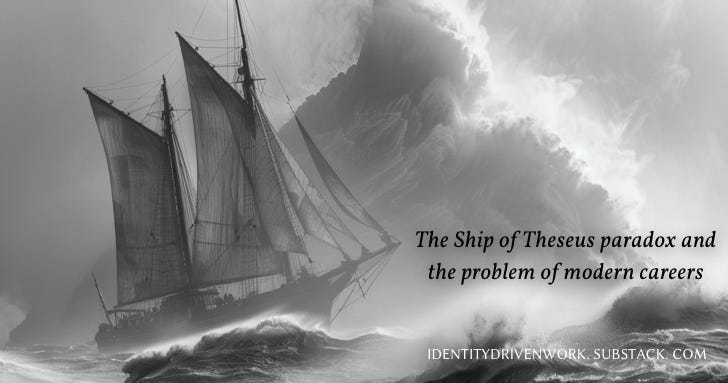
The ship used by Theseus, the legendary Greek hero and king, to return from Crete, was preserved as a memorial by the Athenians. Over time, the wooden hull of Theseus’s ship began decaying. So the Athenians took away the rotten planks and replaced them, one by one, with newer, stronger ones.
And this is where the paradox begins. If, with time, every single plank of the ship was swapped out, then is it still the same ship?
On some deeper level, this paradox mirrors our own becoming.
You are the ship of theseus
You’ve been replacing your “planks.” You’ve been replacing your skills, your job titles, your industry knowledge, your professional identity. Maybe not deliberately. Maybe not by choice. But by necessity. Because that’s what feels safe to pursue.
What you learned five years ago? It’s outdated now.
The roles you trained for? They were automated or outsourced.
The expertise you built your career on? It’s easily replaceable now by someone younger, cheaper, faster, or maybe even by an AI that doesn’t eat, doesn’t complain, doesn’t get tired, doesn’t sleep, and never asks for a raise.
So, yes, you swap the planks.
You pivot.
You upskill.
You reinvent.
You adapt.
And one day, you look back at your career. You look back at this ship you’ve been so frantically rebuilding while trying to keep it afloat, and you realize: Nothing is left of the original.
So questions start plaguing your mind.
Am I still me?
Am I still the same person who started this journey?
Or have I become someone I don’t recognize in the pursuit of staying relevant?
Someone entirely different?
And if I really am entirely different... when exactly did the change happen? Which plank was the last piece of “me”?
But thinking of this as a failure of self-knowledge or even of commitment would be a mistake. Because you didn’t choose this.
This isn’t you being flaky, or being uncommitted, or even lacking vision. It’s the ocean we’re all swimming in. This is the modern reality resulting from…
an always accelerating economy
It’s a socio-economic system that has turned the constant, radical reinvention from a choice into an imperative necessary for survival.
Consider the numbers, for instance:
The time it takes for a skill to lose half of its value or relevance is known as its half-life. Speaking plainly, it’s how long it takes for what you know to become worth half as much in the job market. That half-life of skill is rapidly collapsing.
Forty years ago, what you learned stayed somewhat relevant for roughly over a decade. Today, the World Economic Forum estimates it’s just 4 years. In AI and digital fields, it’s down to ~2 years, and shrinking fast.
A structural necessity is emerging. The average person will hold multiple jobs across multiple different careers in their lifetime. Why? Because industries are abruptly collapsing, technologies are consistently disrupting, and entire professions are evaporating overnight.
The other day, I was using Perplexity to research a product idea. 20 minutes in, I scrolled back up to double-check something, and a deeper realization dawned on me. What used to take me weeks to accomplish was effortlessly done in those 20 minutes.
The thing I thought I was somewhat of an expert in... was now just a prompt someone types into a GPT. And this will be the reality for many of us, if not already. AI is briskly automating entire skill sets that people spent years building.
And we are being told that the response to all of this isn’t to “slow down” or “find stability.” It’s to Pivot. Pivot faster and faster.
The gospel being widely preached is:
Adapt or die.
Reinvent yourself quarterly.
Your career is a perpetual beta test.
And so you do it.
You swap the planks of your ship.
You learn the new emerging tools.
You adopt those new frameworks.
You signal those new competencies.
You become fluent in that new language.
You stay afloat.
But what happens when you replace planks too fast, with no regard for what their effects are on the ship? What happens then?
You stop asking if the new plank even fits your ship’s design.
You stop asking if the new planks affect the direction.
You stop asking if you’re building toward something coherent.
You just ask: Will this keep me from sinking? Not knowing if you have more time to consider what those newly replaced planks are doing to the ship, because culture has led you to believe otherwise. It has led you to believe there is no time.
And that last question, “Will this keep me from sinking?” when repeated hundreds of times over the years, leads to one thing you only figure out in hindsight.
Yes, you’re moving. Yes, you’re busy. Maybe, by some obscure metric, you’re being productive. And probably, you’re even “growing.”
But you lose track of the ship’s direction. You’re not going somewhere deliberately. You’re just rolling with the tide, drifting with the current, while replacing planks as they rot, hoping you don’t capsize. And…
the drifting costs you things
Not all at once.
But slowly.
Incrementally.
Plank by plank.
And year after year.
Until one day…
you realize what you’ve actually lost
You wake up one day and realize something for the very first time. You’ve been sailing for years, maybe even decades, but you have no idea toward what?
You changed jobs because it paid more. You pivoted because everyone said you should. You learned the hot new skill because LinkedIn told you it was the most essential thing for your professional trajectory.
And now?
You’re exhausted.
Accomplished, yes.
Credentialed, definitely.
But, maybe, somewhat hollow.
You’ve been moving fast.
You’ve been replacing planks.
But you haven’t been going somewhere intentionally.
Because you never paused to take stock of the ship or its direction.
You’ve been sailing with whatever wind was strongest, and not toward any harbor you actually chose. The promotions felt good in the moment. The pivots felt smart. But when you zoom out, there’s no coherent story. No destination you could point to.
All your life, you’ve been assembling a resume.
But resumes live on paper.
And they don’t have souls.
You look at your work, you look at the presentations, you reflect on the projects you have done, you see the strategies you have crafted and…
you can’t find your own voice in any of it
Every project feels like a remix of the past, of someone else’s playbook. Every decision sounds like something you heard somewhere already, maybe in some podcast on Spotify or a YouTube video.
Every approach you seem to take ends up mirroring the “best practices” you learned from someone else’s framework, or from a consultant, or from a case study, or from the weekly edition of Harvard Business Review. Because you’ve now become fluent in the language of your field.
But, somewhere deep down, you can still feel the loss of what made your own voice truly yours. When you were younger, a time before you learned “the right way” to do things, you had instincts. Even weird ideas. The kind of approaches that felt yours and yours alone, even if they were rough or unpolished.
But now?
You’re technically excellent.
You know all the right moves.
You can execute most things almost flawlessly.
Yet nothing you create feels truly original.
Nothing feels like you could have been the only one to come up with it.
You’ve swapped so many planks, you’ve adopted so many trends, tools, and techniques that the ship doesn’t look like yours anymore. It just looks like everyone else’s.
So you wonder sometimes: If I disappeared tomorrow, would anyone actually notice? Or would they just slot in someone else who learned from the same playbooks? Exactly like I did.
And…
it’s not just your past self that feels like a stranger
The one from your own LinkedIn profile from years ago.
It’s your current self, too.
Over the years, you’ve learned to be a certain specific way. Speak a certain specific way. Show up in a certain specific way. You’ve built a very specific professional persona. That persona is polished, competent, unflappable, and sophisticated.
But somewhere along the way, the persona stopped being just some act you put on, and became something you are.
Except you’re not. Not really.
There’s a you underneath the “act” of the persona. But you’ve lost touch with that person. You’ve spent so much time managing how you’re perceived, swapping emotional planks left and right to fit different contexts, that you’ve forgotten what the real you actually feels.
Almost all of your new relationships feel transactional. The new friendships seem shallow. Your family sees you, but they don’t really see you. Do they? Because you’re not sure there’s anything left to see beyond the role, to see beyond the act of the persona.
You’re present, but you’re not there. Not really.
You wore the mask as a necessity. And you can’t take it off anymore, because you’re not sure there’s a face underneath.
And you already know what the worst part is. The mask works. People respect it. Promote it. Reward it. But, at the same time, you’re lonely behind it.
And then…
there’s the toll on your body
It’s tired.
Not “I worked hard this week” tired.
Not “I need an extended weekend” tired.
And not even “I need a vacation” tired.
Tired in a way that sleep doesn’t fix anymore.
Tired right down to your bones.
Tired in a way that makes you wonder if this is just what being an adult feels like for everyone else.
You’re running at a pace your body was never designed to sustain. The ship is always under repair. You’re always replacing planks, always learning new skills, always adapting to the next change.
And your body is screaming.
The stress. The insomnia. The reliance on caffeine to function during the day and alcohol to wind the night down. The way you get sick more often. The way you snap at people you love over nothing.
You’re not just tired. You’re running beyond your design specifications. You’re pushing past your natural capacity because that’s what the always-accelerating economy demands from you.
And your body keeps the tally.
These costs don’t show up all at once.
They accumulate slowly.
Plank by plank.
Year after year.
Until one day, you’re standing on a ship that’s seaworthy, functional, even successful by external measures.
But it doesn’t feel like yours.
And you don’t feel like you.
So…
what’s the answer?
Taking a sabbatical, going soul-searching, or even trying to figure out your “true self” and then rebuilding from there?
Maybe you’ve already tried all of those. Maybe you’ve taken the break, you’ve done that journaling, you’ve attended that retreat.
And maybe you came back clearer. More centered. More focused. And what felt like more you. And perhaps for about six weeks, everything felt different.
But then the cultural pressures kicked right back in. A new skill became essential, or a reorganization happened, or AI disrupted your workflow, or the industry shifted again.
And you were right back to swapping planks.
Because there’s a deeper truth at work here.
One that was always staring at you, even if you were looking away.
That truth is: You can’t stop replacing planks. Ever.
The world isn’t going to slow down and wait for you to finish your inner work.
Skills will keep on expiring.
Technologies will keep on disrupting.
Industries will keep on shifting.
The winds will keep on changing.
The planks will keep on rotting.
And you will have no choice but to replace them.
So “finding yourself” and then trying to hold that self constant isn’t going to be the strategy that would work.
Because the question never was, “How do I stop changing?”
The question always was, and will always be:
“How do I change without disappearing?”
And that question does have an answer. One that might have been hiding in plain sight all along, inside the Ship of Theseus paradox.
When we ask, “Is it still the same ship?” we often fixate on the planks, since they’re the parts that are most ostensibly visible. They are the things we can point to and say, “Look, these are different now.”
But there’s one part of a ship that is generally considered permanent, like a foundational structure. It almost never gets replaced.
It’s what holds everything else together. It’s…
the keel of the ship.
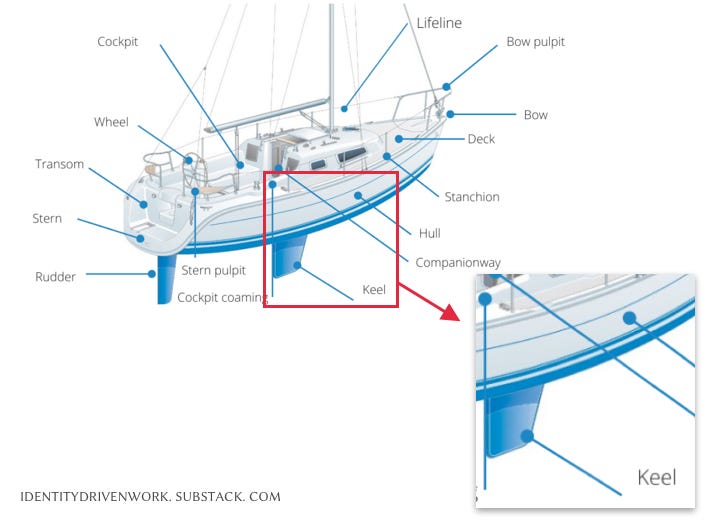
You can’t see the keel when you look at a ship. It’s always submerged, always hidden beneath the waterline. But it’s doing a crucial job. It keeps the ship stable when the waters get rough. It prevents capsizing when the wind shifts violently.
The ship’s keel determines where it can go, which harbors it can reach, which waters it can navigate, and what sort of journeys it’s actually built to make.
The planks can be changed.
The sails can be upgraded.
The rigging can be modernized.
But if you replace the keel?
You don’t really have the same ship.
The continuity, that throughline we touched on earlier, isn’t in the visible parts. It’s in the structure underneath. So…
what’s the keel of your identity?
It’s not your skills.
It’s not your job title or industry.
It’s not even your goals, because goals can change as you learn what actually matters to you at different times in your career and life.
Your identity keel is something deeper. It’s the thing that makes you say “I won’t do that” even when everyone else might be doing that. It’s the principle you’d defend even when defending it costs you that promotion. It’s what you’d refuse to compromise on even if refusing meant you’d have to start all over.
Your identity keel is the answer to the question:
“What kind of person do I want to be, regardless of what I end up doing for a living?”
Your keel isn’t aspirational. It’s not the person you wish you were or the values you think you should have.
It’s what has always been true about you all along. It’s what you would always choose when the choice is between you and your own conscience.
And here’s something most people find out when they actually look for their keel: They never realized they already have one.
And now, it’s so buried under years of plank-swapping that they can’t tell what the underlying structure is, and what’s just accumulated debris.
They’ve been so busy adapting, they’ve been so frantically learning the new thing, pivoting to the new opportunity, becoming who they needed to be to survive, that they never stopped to see that foundation in the first place.
And they don’t just end up drifting. They end up drifting without even realizing there’s supposed to be something underneath holding them steady.
But when you do know your keel, when you do know what it is, and you’ve gone a step further and built your life around it, then you can still change everything, but it would never feel like disappearing. Because the planks of your ship can change, but the core structure always holds.
The continuity isn’t in doing the same work. The continuity is in being the same kind of core person while doing different work.
Someone who knows their keel can look back at that LinkedIn profile from years ago and trace the thread. And not because nothing changed. As a matter of fact, almost everything has changed. But the changes were intentional renovations, not unconscious erasures.
The ship might look different. It might even move differently. It would definitely go to different places. But it’ll still be the same ship. Because it always had the same keel.
The problem isn’t that we’ve been changing.
The problem is that we’ve been replacing planks without knowing what we’re building toward.
We’ve been reacting. Adapting. Surviving.
Learning whatever skill keeps us employed.
Pivoting to whatever industry is hiring.
Adopting whatever framework or system is trending.
And all of that frantic swapping, done without the knowledge of the foundational keel guiding our choices, has brought us here:
Accomplished.
Capable.
Credentialed.
But completely unmoored.
There’s no throughline. No story that makes sense.
Just a series of pivots that seemed smart at the time but added up to... what, exactly?
That’s what happens when we swap planks without knowing how they affect the keel.
The ship stays afloat. For a while.
But it doesn’t go anywhere.
It just drifts with whatever current is strongest.
And eventually, we look around and realize:
We’re not sure where we are.
We’re not even sure where we wanted to be.
We just know this... isn’t it.
So…
what happens when you know your keel?
You stop asking “What should I become next?” and start asking “How does this change serve who I already am?”
You stop learning skills because everyone else is learning them.
You start learning skills because they’re tools that let you do your work better.
You stop pivoting just because the algorithm told you to.
You start pivoting because the new direction lets you express your principles in a different context, and in a far better way.
The planks still change.
They have to.
That’s the underlying truth.
But now the changes mean something.
They’re not random.
They’re not desperate.
They’re not just “whatever keeps me employed.”
They’re renovations.
They’re upgrades.
They’re improvements to a ship that already knows where it’s going.
And here’s what most people discover when they finally do this work, when they stop swapping planks in a panic and pause to consider what this swapping actually does to the keel: The relief is almost physical.
Indeed, the options might still be the same. But the lens through which you view those options now has criteria. You know what you’re building toward. You know what you’re not willing to compromise on. So, decisions get easier.
Someone offers you a role that pays more but requires you to violate your keel?
You can say no without agonizing for weeks.
A trend emerges that everyone’s jumping on, but it doesn’t fit your foundation?
You can let it pass without FOMO eating you alive.
An opportunity appears that does align, even if it’s risky, even if it’s a sharp turn from where you’ve been? You can take it with confidence, because you know it doesn’t represent a drift. It represents an intentional choice of direction.
A career built this way doesn’t feel like a resume.
It doesn’t feel like a list of disconnected roles that happened to the same person.
It finally feels like a story.
Maybe not a neat one.
Maybe not one you could have predicted at the beginning.
But one that makes sense when you share it.
One where each chapter connects to the next, even when the settings might have changed completely.
You can look back at yourself from years ago, at that stranger, and still trace the line.
You can say: “That was me learning what I didn’t want. That was me testing whether I could compromise on... That was me discovering what actually matters more than I thought.”
The planks are different.
The ship looks nothing like it did.
But the keel? The keel is still there, just like always.
So here’s the question:
Look at the ship of your own career.
Are you just replacing planks in a panic?
Or are you building around a keel you actually trust?
Can you name it? Your keel?
Not the values you think you should have.
Not the principles that look good on paper.
The real ones.
The ones that have actually guided you when the choice was hard.
The ones you’ve defended even when it cost you something.
If you can name them, if you can feel them beneath the surface, holding steady while everything else shifts, then you’re not drifting. You’re sailing.
But…
what if you can’t name your keel?
Then that’s where we start.
Not by figuring out your next move.
Not by optimizing your resume or learning that hot new trending skill.
But by finding your foundation, finding your keel.
Because once you know your keel, the rest gets easier.
Not easy. Easier.
You’ll still have to replace planks.
The world isn’t waiting around.
But you’ll know why you’re replacing them.
And you’ll know which ones to keep, which ones to discard, and which ones were never yours to begin with.
You’ll stop feeling like a stranger in your own story.
And you’ll start feeling like the captain of a ship that’s finally, finally going somewhere you actually want to take it.
If you saw yourself in this letter, and you can’t name your keel…
Then you might be battling Purpose Deficit. It’s the misalignment between your work and your deeper values.
If you feel your need is urgent and requires focused, custom work on finding your Keel, then you can drop me a private message.
If this letter resonated with you, make sure to share this post.
That’s all for this time. See you in the next one.
Stay genuine! Stay authentic!
Nik Pathran
PS: If this letter made you pause, do this one exercise. Write one line you’d never trade. Ever. Not for a raise. Not for a promotion. Not for a higher paying job.
And keep that line where you can always find it.
Reverse Your Identity Debt
Subscribe to Identity-Driven Work for
the weekly insights on building
a body of work that is authentically yours.
Read More
On the Overclocked Archetype

Great piece Nik.
The analogy you used is pretty interesting and powerful. I have never thought about the idea of a keel before.
I can see myself a lot in that Perplexity story. AI allowed me cut down what used me to take weeks into a couple of hours. Powerful. Stunning even. Without the expertise I built it wouldn't work, but I realized that it's time to adapt.
as an artist i see this as many little added dimensions…
the time dimension is fascinating… the velocity the speed direction& change.. its not just on paper in 2d/3d anymore… its not even a video that moves as in last century… kids have more to learn& catchup to have meaningful depth in understanding…
we see things along our journey changing… faster than they were in agricultural or industrial times… the digital age blurs many things as people travel faster….our minds are learning& coping by more use of digital devices… the world seems to change… when kids watch a time lapse video… but taking time to help a plant grow watching the real time it takes a different depth if understanding… when time moves faster, or distance covered seems more… the added dimensions bring greater perspective into things we do…