

The Slow Disappearance
On the cost of being so good at fitting in that you forget what you actually think.

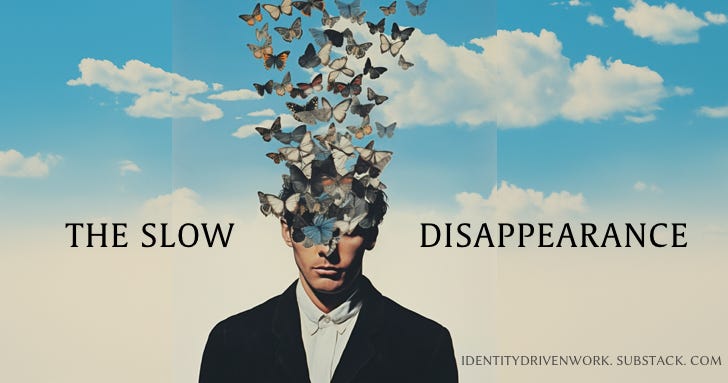
That Moment You Can't Find Your Own Opinion
"So what's your take?"
The question hangs in the air. The people at the dinner table lean in slightly. You all have been discussing a viral article for a while. And your friends are genuinely interested in your perspective on something that, from the outside, appears to be simple.
But for a moment, that in fact feels like an eternity, you feel... nothing.
This "nothing" is not like that diplomatic nothing of someone being polite.
This "nothing" is not even that strategic nothing of someone calculating the right answer.
This "nothing" is a true void. An absence where a perspective should be. It's the disorienting, almost nauseating "nothing" when the mind reaches for an opinion... and finds that it simply doesn't exist.
Your mouth opens. You try to buy time with "Well..." as your mind frantically scans the conversation for clues. What would make your friends nod approvingly? What position would fit most naturally into this particular social ecosystem?
While all this is unfolding like a familiar choreography of social calibration you are so used to by now, something else is happening underneath. There is a slow, creeping recognition.
You don't actually know what you think.
Not because you haven't formed an opinion yet. No. But because your perspective is now hardwired not to begin with the question, "What do I think?" but with the question, "What would everyone approve?"
You have edited and re-edited your actual perspective so many times on so many occasions that there's nothing left of the original.
So what do you do? You settle on something agreeable, something that creates the least friction, something that deflects the spotlight, and watch as the conversation moves forward.
No one notices the moment of hesitation.
Why would they? You've become extraordinarily skilled at making this look effortless.
But you notice.
And for the first time in a very long time, the speed, the smoothness of your own adaptation frightens you.
The Archaeology of "Reading the Room"
I was twelve when I learned that our enthusiasm can be too much for certain rooms.
I had rushed home from school, backpack still bouncing on my shoulders, bursting to share my excitement. I was selected to represent my school in the inter-school volleyball meet. It was a pretty big deal for that 7th grader me.
I found my father sitting in the drawing room, along with his Indian Air Force colleagues. I was practically vibrating with exhilaration when I said:
"Papa! Papa! You know what happened? I was..."
But the look on his face stopped me mid-sentence. I felt my shoulders drop. His expression wasn't anger, exactly. It was something much more subtle. It was a kind of tired impatience that communicated clearly to me: read the room.
It became evident to me that I had violated that unspoken rule. And the silence that followed felt heavy. My energy, my enthusiasm, my excitement... were taking up space that wasn't available.
I learned something that day: scan first... then speak.
With time, I developed a system. A sophisticated one at that, I might add. I became adept at reading people's micro-expressions that indicated whether my natural response was welcome. I learned to modulate my tone and pitch to match the energy of the room. I mastered the act of adjusting my perspective to fit the conversational container I was in.
It was a coping skill, really. And like most coping skills developed in childhood, it was brilliant but also devastating.
I got really good at being exactly what was needed. I became the student who never challenged the teacher in ways that would disrupt the class flow. I became the son who never made family gatherings more complicated than they already were. I became the friend who never created that awkward silence. And years later, I became the professional who never overstepped the bounds.
The praises were consistent:
"You never cause problems."
"You're so easy to get along with."
"You have such good judgment about these things."
But what they were really praising, I later realized, was my ability to disappear while remaining fully present.
The Vanishing Act
What shouldn't be underestimated is how sophisticated this skill really is.
Like a meteorologist reads weather patterns, you learn to read the rooms. You develop an ability, bordering on supernatural, to detect the subtle shifts. The change in someone's posture that indicates what kind of opinion might be forming. The slight fluctuation in someone's tone that signals you should adjust course. The switch in group dynamics that determines which version of yourself will be most welcome.
Unknowingly, unconsciously, you become fluent in the language of accommodation. You master the art of having a range of strong opinions that somehow never quite conflict with anyone else's strong opinions.
You develop a repertoire of phrases that sound substantive... but are really just mirrors reflecting what others want to hear.
"I think there's truth in what you're saying."
"That's such an interesting perspective."
"I can see both sides of this."
These aren't lies, exactly. These are rather diplomatic truths that allow you to participate without ever really showing up.
And what are the professional rewards of all this? You're seen as collaborative, flexible, open-minded, and a team player. You get invited to all those meetings because you don't make them more difficult. You're the person your boss trusts to handle sensitive situations because you never really make waves.
But there's a debt. It’s a specific kind of Identity Debt. It accumulates slowly, quietly over time.
Colleagues respect your opinions, except that none of those opinions are actually truly yours. Your friends value your perspective, but it’s the kind of perspective that’s always carefully curated to maintain that perfect group harmony. You're included in almost every important conversation, yet somehow you're absent from all of them.
You shuffle to calibrate your opinions in meetings. You adjust your social media posts to the point you can't even recognize it's coming from you.
A realization slowly dawns on you.
You've become the conversational equivalent of the color beige. Universally acceptable, rarely memorable, almost unremarkable, and never quite substantial enough to leave a lasting impression.
The most unsettling part isn't even what others think of you.
It's what you truly discover about yourself.
You start to lose trust in your own judgment. Not because it's poor, but because for so long you've had so little practice using it. When forced to make decisions in the absence of social cues to guide you, you feel devastatingly unmoored. When asked for your authentic opinion in moments when diplomacy is off the table, you reach for something that feels like it should be there, but only to find a collection of heavily edited perspectives.
In the end, you become so skilled at being what others need that you forget how to be anything else... how to be anything that might resemble you.
The Voice Underneath
There are obvious recommended solutions:
• Find your voice.
• Be more assertive.
• Express yourself boldly.
But this advice misses something crucial, something fundamental.
The problem isn't that you don't know how to use your voice. After all, all that social calibration has made you remarkably articulate. The problem is that you don't even know what you actually want to say when your opinion doesn't need to satisfy someone's approval.
The work isn't about being assertive.
The work is learning to listen inward before you listen outward.
Since you haven't done it in a long time, having an opinion before you know whether it's acceptable to others will make you uncomfortable. Feeling something strongly before you've calculated whether that feeling is welcome in the room will be unnerving. Discovering what you think before you know what everyone else would endorse will be unsettling.
But this isn't a call to a sudden rebellion or a reckless form of authenticity. Because being authentic is never a license to be unkind.
So what is this really? It's an invitation to a form of courage. It's the willingness to know your own mind.
Because this distinction matters.
A healthy adaptation means choosing how you express your perspective based on the context you are in and the care for others.
Self-erasure, on the other hand, means you lose access to what your perspective would have been in the first place.
One preserves your center while tuning your expression.
The other slowly, unconsciously dissolves your center entirely.
Yet the path back isn't dramatic. It doesn't require burning your bridges or suddenly becoming difficult. But it does require something much more subtle and, in many ways, more challenging.
It requires learning to pause.
The next time someone asks what you think, try it. Pause. Not to calculate the right answer, but to discover if you have one that's actually yours.
The silence might ostensibly be uncomfortable, but it's the sound of your voice trying to remember how to exist.
This pattern of disappearing while remaining fully present, of becoming the conversational equivalent of the color beige, is not just some personal quirk. It is a specific, recognizable pattern of behavior that arises from a deep-seated Creativity Deficit of Identity Debt.
In the work I do, I call this pattern: The Chameleon Archetype.
It is one of several common archetypes that define how we accumulate Identity Debt.
Understanding your primary archetype is the first, most critical step in beginning to repay your Identity Debt. To that end, I’ve been developing a new diagnostic tool designed for one purpose: to give you that clarity.
It’s called the Identity Debt Assessment.
It’s specifically designed to help professionals identify their core patterns.
It is not quite ready for its public launch, as I’m still calibrating it based on real-world scenarios, but it will be released exclusively first to my newsletter subscribers in the coming weeks.
If this article resonated with you, make sure you are subscribed to be the first to get access. It’s the logical next step.
That's all for this time. See you in the next one.
Stay genuine! Stay authentic!
Nik Pathran
PS: The hardest part about writing this letter was recognizing how often I still catch myself scanning for approval before I know what I actually want to say. The pattern runs deep, but awareness is the only path to choice.
Reverse Your Identity Debt
Subscribe to Identity-Driven Work for
the weekly insights on building
a body of work that is authentically yours.
Your letter articulates the identity debt aptly, Nik
Most of us have been there, many don’t realise even and keep playing along. Loved the advice to connect inside before connecting outside.
Curious if you've noticed it too. I've noticed it in one person I knew very well, including who he studied... not sure if I'd be able to see it otherwise.
In a conversation, I recognized he was expressing opinions of those whose opinions he respected. He didn't say it's this and that person's work. He made it sound like his thoughts on the subject. And he'd always speak it with drive and confidence.
The effect was the same as you mentioned - it made him appear as someone who has good observations, insights, philosophy, but it wasn't his own.